

The American flap T
The flap T is the quick tap Americans use for a T between vowels before an unstressed syllable, as in water, better and city. Your tongue tip taps the ridge behind your top teeth once while your voice keeps going. Written [ɾ] in IPA, it is why “water” sounds like “wadder.”
See the sound
What does a flap T sound like?
A flap T sounds like a very quick, light D: one tap of the tongue with the voice running straight through, where a released T stops the air and then bursts. BoldVoice coach Ron Carlos says “better” both ways below.

The air stops, then explodes. Clear, but careful and separate.
One quick touch. The voice runs straight through: BEH-der.
The rule
Why does “water” sound like “wadder”?
“Water” sounds like “wadder” because American English turns a T into a voiced tap between two vowel sounds, before an unstressed syllable. Wa-ter is stressed on WA, so the T before the weak syllable taps.
Between vowels, before an unstressed syllable
The core rule. A T (spelled t or tt) between two vowel sounds, before a weak syllable, taps: wa-ter, bet-ter, ci-ty, la-ter. So does a T before an unstressed syllabic L (little, total), and an R before the T counts as part of the vowel (party, forty, thirty).
Across word boundaries
A word-final T after a vowel taps when the next word starts with a vowel, even a stressed one. That is how everyday speech glues short words together.
get it · a lot of · what is · shut up · not at all
D flaps too
A D in the same spot becomes the same tap, so these pairs usually sound identical in American English. Context tells them apart.
ladder / latter · medal / metal · body · riding
Tap to hear
Flap T examples: 12 everyday words
Common flap T words include water, better, data, little, city, later, butter, pretty, photo, party, thirty and forty, recorded here by BoldVoice coaches Ron Carlos and Eliza Simpson. In the respellings, the d stands for the quick tap, not a full D.
| Word | Ron | Eliza |
|---|---|---|
| waterWAH-der [ˈwɑɾɚ] | ||
| betterBEH-der [ˈbɛɾɚ] | ||
| dataDAY-duh [ˈdeɪɾə] | ||
| littleLIH-dl [ˈlɪɾl̩] | ||
| citySIH-dee [ˈsɪɾi] | ||
| laterLAY-der [ˈleɪɾɚ] |
| Word | Ron | Eliza |
|---|---|---|
| butterBUH-der [ˈbʌɾɚ] | ||
| prettyPRIH-dee [ˈpɹɪɾi] | ||
| photoFOH-doh [ˈfoʊɾoʊ] | ||
| partyPAR-dee [ˈpɑɹɾi] | ||
| thirtyTHUR-dee [ˈθɝɾi] | ||
| fortyFOR-dee [ˈfɔɹɾi] |
Tap T vs true T
When does T stay a T?
T stays a full T at the start of a word (tell), before a stressed syllable inside a word (attack) and after S, F or K (after). Before a syllabic N it usually becomes a glottal stop, and after N it is often dropped in casual speech.
At the start of a word or a stressed syllable
Here T is a full T with a small puff of air, including right before a stressed syllable: attack, atomic, Italian. Compare atom (AD-um, flapped) with atomic (uh-TAH-mik, true T).
| Word | Ron | Eliza |
|---|---|---|
| tellTELL [tʰɛl] | ||
| tableTAY-bl [ˈtʰeɪbl̩] | ||
| tacoTAH-koh [ˈtʰɑkoʊ] | ||
| teethTEETH [tʰiθ] |
Two Ts, two treatments
In potato, the first T starts the stressed syllable, so it stays a T; the second sits before a weak syllable, so it taps: puh-TAY-doh.
| Word | Ron | Eliza |
|---|---|---|
| potatopuh-TAY-doh [pəˈtʰeɪɾoʊ] | ||
| tomatotuh-MAY-doh [təˈmeɪɾoʊ] | ||
| totalTOH-dl [ˈtʰoʊɾl̩] |
After a consonant, or before N
After S, F or K
T stays a plain T: mister, after, doctor, actor.
Before a syllabic N
In button, cotton and mountain, Americans usually close the throat briefly instead of tapping (a glottal stop), then go straight into the N.
After N, in casual speech
Many Americans drop it when speaking fast, so twenty can sound like “twenny”. A clear T there is always fine.
Mouth position
How do you make the flap T?
To make the flap T, flick the tip of your tongue once against the ridge behind your top front teeth while your voice keeps going, like a D said so fast and lightly that it barely happens.
Start on the vowel before the T, with your voice on: the “ah” in water.
Lift the tip of your tongue to the ridge just behind your top front teeth.
Touch it once and let it bounce straight off. No pressure, no hold, no puff of air.
Keep your voice running into the next syllable: WAH-der.
Three ways the tap slips away
- It sounds like a full D. Your tongue stayed on the ridge too long. Make the touch shorter and lighter.
- It sounds like a full T. The air stopped and burst. Keep your voice on through the touch.
- It sounds like “wa’er.” The throat closed instead of the tongue moving, a glottal stop. Aim the tongue tip at the ridge.
Our data
Which learners find the flap T hardest?
Mandarin and Cantonese speakers find the flap T hardest in BoldVoice practice data: they tap on about 35% of first tries, against about 85% for Portuguese speakers. The figures come from about 26,000 first-ever attempts at 14 common flap words (water, better, little, city and more).
All learners, first try: what came out
- A flap55%
- A D sound20%
- A full T20%
- Something else, or dropped5%
In a wider random sample of BoldVoice practice, the average learner missed the flap about 50% of the time, and the most common replacement was a D.
| Native language | Flap | D | Full T |
|---|---|---|---|
| Portuguese | 85% | 10% | 5% |
| Spanish | 80% | 10% | 5% |
| Korean | 75% | 15% | 5% |
| Tagalog | 70% | 10% | 15% |
| French | 60% | 20% | 15% |
| Hindi | 55% | 25% | 20% |
| German | 50% | 35% | 15% |
| Persian | 50% | 30% | 10% |
| Vietnamese | 45% | 40% | 10% |
| Russian | 45% | 20% | 30% |
| Arabic | 45% | 25% | 25% |
| Japanese | 40% | 25% | 20% |
| Chinese (Mandarin) | 35% | 25% | 35% |
| Chinese (Cantonese) | 35% | 25% | 35% |
Languages that already tap
Portuguese (85%), Spanish (80%) and Korean (75%) speakers flap most often. All three use this tap every day (Spanish pero, Portuguese caro, Korean ㄹ between vowels), and Spanish speakers produce a full T only about 5% of the time. Keep the tap out of the American R in “very”, though: that is a different sound.
Mandarin and Cantonese: the full T
Chinese speakers flap about 35% of the time and say a full T just as often (about 35%), against about 5% for Spanish speakers. Cantonese speakers show the same split. Neither language has this tap, which may be part of the reason.
Japanese: a tap, but not here
Japanese has a tap (the R in ら is often one), yet Japanese speakers flap only about 40% of the time. One possible reason: katakana spellings with a clear T, like ウォーター for water.
By word, the most frequent full Ts were on computer (about 30% of first tries) and party (about 25%): a T after R taps too. Little is the flap word learners miss most on a first try, with about 65% of first attempts under our 90/100 pass mark; it also ends in a dark L, the sound the guide to “world” covers.
How we measured this
Figures come from an anonymized sample of 750,000 BoldVoice practice attempts.
Practice
Practice sentences for the flap T
These six flap T practice sentences mix taps inside words (better, water) with taps that bridge two words (get it, at eight). Read each one out loud; the bold letters are taps.
I’d better get a little water.
What a pretty city!
Let’s meet at eight thirty.
I’ll get it to you later.
The data is on my computer.
Put a lot of butter on it.
How BoldVoice works
Hear exactly where your T lands
Sound natural in real speech
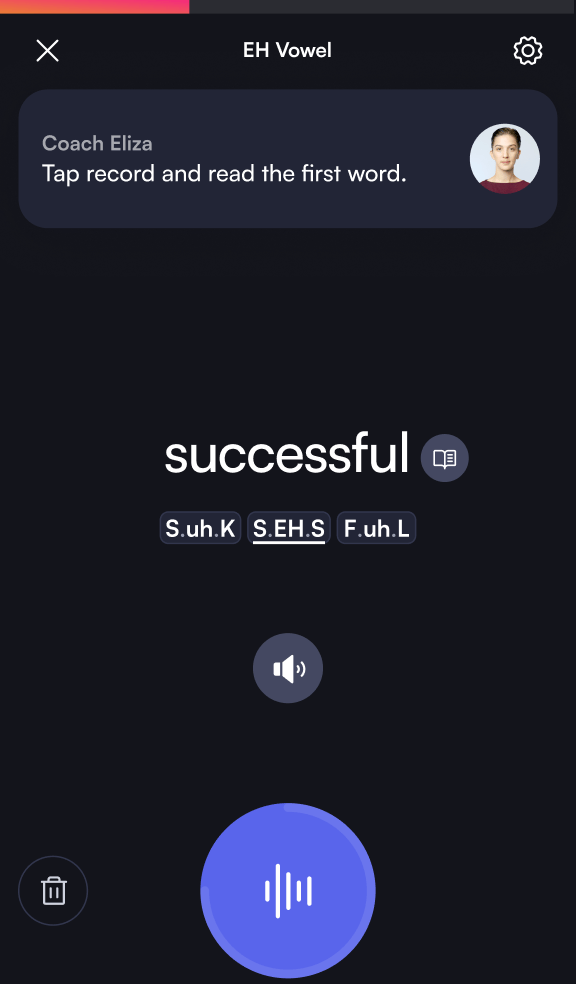
Say a word and the AI scores each sound, so you know whether your T came out as a tap, a D or a full T.
Lessons from Hollywood coaches
Video lessons with coaches Ron Carlos and Eliza Simpson show you the fix up close, like the clips on this page.
Frequently asked questions
What is the flap T?
The flap T, also called the tap T or alveolar tap, is the quick sound American English uses for T between vowels before an unstressed syllable, as in water, better and city. The tongue tip taps the ridge behind the top front teeth once while the voice keeps going. Its IPA symbol is [ɾ].
Why do Americans pronounce T like D?
Because the American flap is voiced and very short. Between vowels, before an unstressed syllable, American English swaps the full T for a quick tap while the voice keeps running, and a voiced tap sounds close to a D to most ears. That is why "water" sounds like "wadder".
Is the flap T the same as a D?
Not quite. A full D holds the tongue against the ridge before releasing it; the flap is a single touch so brief that the voice runs straight through it. In the flapping position, though, T and D become the same sound, so "ladder" and "latter" or "medal" and "metal" usually sound identical in American English.
How do you pronounce "water" in American English?
Say WAH-der, with stress on the first syllable, an open "ah" vowel, and a quick tap in the middle instead of a full T. The ending is the American "er" sound, as in "her". In IPA it is [ˈwɑɾɚ]. If the middle sounds like a held D, make the touch shorter; if you hear a puff of air, keep your voice on through the tap.
What is the difference between a flap T and a glottal stop?
A flap T is one quick touch of the tongue tip on the ridge behind the top front teeth, with the voice running straight through, as in water and better. A glottal stop is a brief catch in the throat with no tongue movement. American English usually uses the glottal stop for T before a syllabic N, as in button and mountain, and many British speakers use it in water (wa'er).
Is the flap T the same sound as the Spanish R?
Yes, for the single R. The R in Spanish pero, the R in Portuguese caro and the Korean ㄹ between vowels are the same tongue-tip tap as the American flap T, written [ɾ] in IPA. The Spanish RR in perro is a different sound, a trill with several taps. Speakers of these languages can reuse the single-R tap for T in water and better, as long as it stays one touch and never rolls.
Do British people use the flap T?
Standard British English usually keeps a crisp T in words like water and better, and many British speakers use a glottal stop instead (wa'er). The flap is typical of American and Canadian English and common in Australian English. All of these are correct. If you learned British English, expect it to be one of the first differences you notice in American films and meetings.
Do I need the flap T to be understood?
No. A full T in water or better is perfectly clear, and listeners will understand you. The flap is a confidence sound, not an intelligibility sound: a carefully released T can sound formal or read aloud, while the tap lets words run together the way they do in relaxed American conversation. Americans use it constantly in everyday words and phrases like a lot of and get it, and classroom English often skips it.
Start with the sounds that matter for you
7-day free trial on iOS, Android and the web.
Last updated