

Speak clear English in Japan
Many learners in Japan read English well but get tripped up by how it sounds: R and L, the extra vowels katakana adds (“street” as su-to-ri-i-to) and English rhythm. BoldVoice trains each one with Hollywood coaches and feedback on every sound, in an app you can use in Japanese.
R or L: which word did the coach say?
Word 1 of 6
Listen, then pick the word.
Why are R and L so hard for Japanese speakers?
Japanese has one sound, the quick tongue-tip tap of the ら row (ra, ri, ru, re, ro), where English has two: R and L. English ears hear that tap as something between R, L and a soft D. Katakana writes both “light” and “right” as ライト, so years of reading English never forced the two apart. On a phone call, with no face or context to help, a listener can hear “right” when you meant “light”.
In BoldVoice data, the average Japanese-speaking learner misses the American R (including R-colored vowels like “her”) about 35% of the time, and the L after a vowel (“feel”, “world”) in about 40%, most often by dropping it.
How to make an English L
To make an English L, press the tongue tip on the ridge behind your upper front teeth and hold it there while you voice the sound. The tap touches and leaves; the L touches and stays.
How to make an American R
For an American R, the tongue tip touches nothing. Pull the tongue back and up, keep its sides against your upper back teeth, and round the lips slightly. Start from a long “rrr”, then open into the vowel: r-r-r-ain. Drill: alternate “la” (tip up, held) and “rrr” (tip pulled back, floating) until they feel like two different places.
BoldVoice data
Beyond R and L: the sounds learners in Japan miss most
R and L get the attention, but in BoldVoice data the sound learners in Japan miss most is the flap T in “water” (about 60% average miss rate), followed by the ER in “work” (45%) and several vowels Japanese does not have.
- Flap T, as in “water”60%
- ER, as in “work” and “bird”45%
- Long O, as in “go”40%
- Short A, as in “cat”40%
- Short O, as in “hot”40%
- AR, as in “car”40%
- Short OO, as in “good”35%
- OR, as in “more”35%
- Voiced TH, as in “this”35%
- Short I, as in “ship”35%
On this page, “learners in Japan” means learners whose BoldVoice account is in Japan, and “Japanese speakers” means Japanese is a learner's native language, wherever they live. Both groups show nearly the same top ten, with ZH as in “measure” in place of TH for Japanese speakers.
How we measured this
Figures come from an anonymized sample of 750,000 BoldVoice practice attempts.
Good news: you already have the flap T
The American flap T is a fast tap of the tongue tip that replaces a T between vowels before an unstressed syllable, as in “water”, “better” and “city”. It is very close to the tap of the Japanese ら row, so many Japanese speakers already make this movement every day.
The hard part is knowing where English spelling hides it. Use your tap for the T in “water”, never for the R in “rain”.
Go deeper in the American flap T guide.
What our scorer heard at the T in “water”, “better” and “city”
First attempts by learners in Japan across common flap T words. A full T counts as correct where the dictionary accepts it, as in “city”.
- A flap40%
- A D sound25%
- A full T20%
- Something else, or dropped10%
Why does “street” become su-to-ri-i-to?
“Street” becomes su-to-ri-i-to because Japanese is built from moras, small beats that almost always end in a vowel; ん (n) and the small っ that doubles a consonant are the exceptions. When English puts consonants together or ends a word on one, Japanese speakers add a vowel, usually u, or o after T and D. Linguists call this vowel insertion (epenthesis). Katakana loanwords lock the habit in: “street” is one syllable in English and five beats as ストリート.
“You're adding an ‘uh’ between two consonant sounds where it doesn't belong.”
Japanese already offers a hint: in everyday speech the u in です (desu) and the i in した (shita) are often whispered. English asks for one step more, no vowel at all: move straight from one consonant to the next, and end a word with the tongue or lips still in position.
Katakana English vs American English
| Word and katakana | Syllables | Beats | Listen |
|---|---|---|---|
| schoolスクール (su-ku-u-ru) | 1 | 4 | |
| milkミルク (mi-ru-ku) | 1 | 3 | |
| strengthストレングス (su-to-re-n-gu-su) | 1 | 6 | |
| worldワールド (wa-a-ru-do) | 1 | 4 | |
| tableテーブル (te-e-bu-ru) | 2 | 4 | |
| videoビデオ (bi-de-o) | 3 | 3 |
“World” is a good test: it fails on the first try for about 70% of Japanese-speaking learners in BoldVoice. The guide to pronouncing “world” walks through it sound by sound.
Five vowels in Japanese, many more in English
Japanese has five vowels (a, i, u, e, o), each short or long. American English has more than a dozen, and pairs like “fit” and “feet” differ in tongue and lip shape, not only in length. In a quick exchange, like ordering at a counter, one vowel can change the word your listener hears.
Short A, as in “cat”
/æ/40% average miss rate, learners in Japan
Often said as the “ah” of “hot”, so “cat” drifts toward “cot”. Drop the jaw and spread the lips a little more.
Short I, as in “fit”
/ɪ/35% average miss rate, learners in Japan
Often said as the Japanese “i”, so “fit” sounds like “feet”. Relax the tongue and lips: it is a different vowel, not a shorter one.
Short OO, as in “good”
/ʊ/35% average miss rate, learners in Japan
Often said as the tense “oo” of “food”. Keep the lips loose and the sound short.
Long O, as in “go”
/oʊ/40% average miss rate, learners in Japan
Often held as a pure Japanese “o”. The American O glides, closing the lips toward a W at the end.
ER, as in “turn”
/ɝ/45% average miss rate, learners in Japan
Most often flattened into a plain “uh” with no R. Pull the tongue back and hold the R through the whole vowel.
Schwa, the unstressed “uh”
/ə/30% average miss rate, Japanese speakers
English shrinks most unstressed vowels to a short, relaxed “uh”: the a in “about”, the o in “today”. Saying them fully makes words sound stressed in the wrong place.
TH, V and F: sounds katakana rounds off
Most katakana loanwords spell TH, V and the English F with the nearest Japanese sound: S or Z for TH, B for V, and the two-lip ふ for F. Those swaps carry over into spoken English.
TH, as in “think” and “this”
/θ/ /ð/25% (think) and 35% (this) average miss rate, Japanese speakers
Katakana uses the S and Z rows for TH (サンキュー, sankyū, for “thank you”), so “think” most often comes out with an S and “this” with a D. Rest the tongue tip lightly between your teeth and blow air over it, with no buzz for “think” and buzz for “this”.
V, as in “video”
/v/20% average miss rate, Japanese speakers
Most loanwords write V with the B row, so “video” is ビデオ (bideo) and V most often comes out as B. Rest your upper teeth on your lower lip and push voiced air through; the lips never close.
F before U, as in “food”
/f/The Japanese ふ (fu) is made with both lips, like blowing out a candle. The English F uses the upper teeth on the lower lip, the same place as V but with no voice.
From mora timing to English stress
Japanese is mora-timed: each mora gets about the same length. English is often described as stress-timed: stressed syllables are longer, louder and higher, and the unstressed ones between them shrink and speed up. Japanese marks words with pitch instead: in Tokyo Japanese, 箸 (chopsticks) is HA-shi and 橋 (bridge) is ha-SHI. Stress is also what tells “thirteen” from “thirty” when you give a number on a call.
Stress can move inside a word family, and the vowels change with it: PHO-to-graph, pho-TOG-ra-phy, pho-to-GRAPH-ic. Try “productive”, one of the words Japanese speakers miss most on a first try: pro-DUC-tive, with a short, light “pro”.
BoldVoice data
The words Japanese speakers miss most on a first try
In BoldVoice data, the words Japanese speakers fail most often on a first try are “worthwhile” (about 90% fail) and “entrepreneur” (90%), out of the common practice words with enough Japanese-speaking learners to rank. A first try fails when it scores under 90/100. Most of these words hide a TH, an R or L, or a vowel Japanese does not have.
- worthwhile90% failed first tryPractice
- entrepreneur90% failed first tryPractice
- original85% failed first tryPractice
- travel85% failed first tryPractice
- brotherhood85% failed first tryPractice
- authority85% failed first tryPractice
- other85% failed first tryPractice
- cooperate80% failed first tryPractice
- clothes80% failed first tryPractice
How BoldVoice helps you be understood
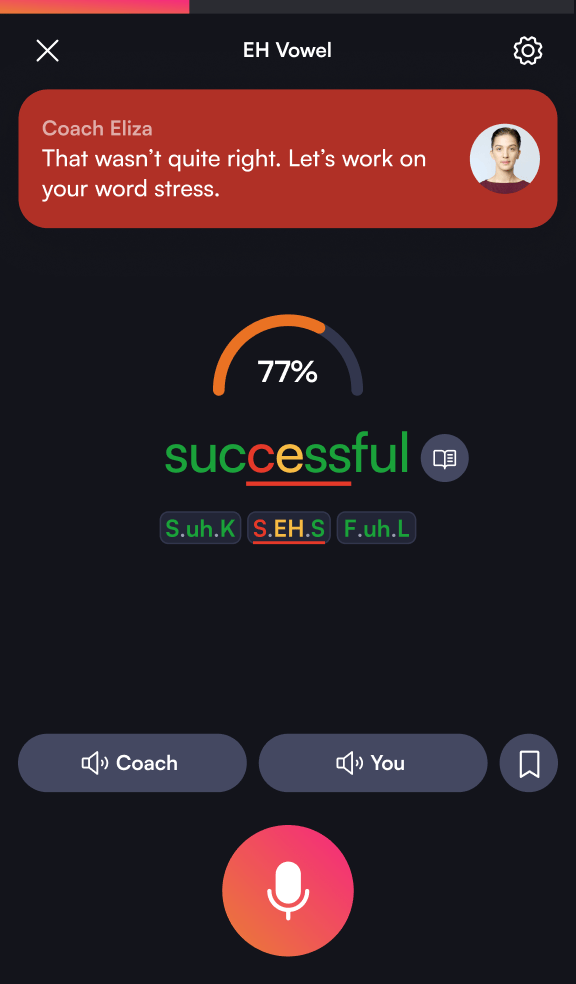
See what gets in the way
Say a word or sentence and BoldVoice scores each sound and your stress, so you see which R, L or vowel makes a word hard to understand.
Lessons from Hollywood coaches
Video lessons with coaches Ron Carlos and Eliza Simpson show the tongue and lip positions up close, like the clips on this page.
In Japanese, wherever you are
The iOS and Android app is available in Japanese, and BoldVoice also runs on the web, in English. 7-day free trial.
“When I first moved to the US, I was honestly really scared to talk to people because I wasn't confident in my English pronunciation.”
Questions from learners in Japan
What is katakana English, and why does it affect pronunciation?
Katakana English is the way English loanwords are written and said in Japanese. They are fitted to Japanese sounds: a vowel after almost every consonant, five vowels, and usually B in place of V. "Christmas" becomes ku-ri-su-ma-su. Because these words feel familiar, the katakana version easily carries into English, adding syllables an American listener does not expect.
Does TOEIC test pronunciation?
The TOEIC Listening and Reading test does not include speaking. The TOEIC Speaking test does: its read-aloud tasks are rated on pronunciation and on intonation and stress, and the other tasks are easier to score well on when you are easy to understand. The standard Eiken test also has a face-to-face interview from Grade 3 up. Clear R and L, no extra vowels and natural stress help on both.
I studied English for years at school. Why is my pronunciation still hard?
School English in Japan focuses on reading, grammar and vocabulary for exams, which is a strong base. What is usually missing is speaking practice with feedback on each sound. Focused practice on R and L, extra vowels and stress, with feedback on each try, helps you be understood at work, on calls with overseas colleagues and when traveling or studying abroad.
Which sounds should Japanese speakers practice first?
Start with the sounds that cause the most misunderstanding and the ones you miss most. In BoldVoice data for learners in Japan, the average learner misses the flap T in "water" about 60% of the time, the ER in "work" in about 45%, and short A in "cat" in about 40%. Add R and L, TH and V, and drop the extra vowels after consonants.
Should I learn an American or a British accent?
The goal is being understood, and both are widely understood. Neither is better, so pick the one you hear and need most. BoldVoice teaches American English pronunciation, which suits you if you work with US colleagues, plan to study or live in the US, or mostly watch American shows.
Is it bad to have a Japanese accent when speaking English?
No. Most adults who learn English keep some accent, and that is fine. What matters is being understood, and that depends on a few specific habits rather than on the accent itself: R and L that sound alike, extra vowels after consonants, and merged vowel pairs like "fit" and "feet". Clearing up those habits makes you easier to follow at work and in daily life.
Can adults change their accent?
Yes. Adults can learn to hear and make new sounds with focused practice and feedback, one sound at a time. Start with the handful of sounds and rhythm habits that make listeners ask you to repeat yourself, practice them in short daily sessions, and move from single words to full sentences once each sound feels steady.
How can I practice English pronunciation on my own in Japan?
Practice in short daily sessions and get feedback on each try. Listen to pairs like "light" and "right" until you can hear the difference, then copy a coach recording and record yourself saying the same word. Shadowing, repeating a native speaker a beat behind, builds English rhythm. The BoldVoice app scores each sound and your word stress, so you know what to fix without a teacher in the room.
Is the BoldVoice app available in Japanese?
Yes. The BoldVoice iOS and Android app is available in Japanese; the web version is in English. There is a 7-day free trial. Its video lessons are taught in English by Hollywood coaches Ron Carlos and Eliza Simpson, and its AI feedback scores your speech down to individual sounds and stress.
Start with the sounds that matter for you
BoldVoice shows which sounds get in the way of being understood, so you practice those first, with video lessons from Hollywood coaches.
7-day free trial. iOS and Android app available in Japanese.
Last updated