

Clear English for Spanish speakers
Spanish has five vowel sounds and American English has more than a dozen, so Spanish speakers often merge vowel pairs like ship and sheep. Other common patterns: Z said as S, an extra E before S (“espeak”), B and V merged, and a tapped R.
Listen first
Why do Spanish speakers say “espeak”?
| Word | Ron | Eliza |
|---|---|---|
| schoolskool | ||
| studentSTOO-dnt | ||
| stopstahp | ||
| storestor | ||
| smallsmawl | ||
| strengthstrengkth |
Start with the hiss
Hold a long “sssss” with no voice before it, then move into the next sound: sss-kool, sss-tor. If you hear a vowel first, your voice started too early.
Lean on the word before
In a sentence, slide from the previous word straight into the S: “my school,” “the store.”
Vowels
Why do ship and sheep sound the same?
Short I, as in “ship”
/ɪ/35% average miss rate, Spanish speakers
Most often said as a long E, so fit sounds like feet and ship like sheep. Long E is close to the Spanish i; for short I, let your tongue drop slightly, relax your lips and keep it quick. Practice the pairs fit and feet, ship and sheep, live and leave.
Short OO, as in “full”
/ʊ/45% average miss rate, Spanish speakers
In about 80% of misses it comes out as the long OO in fool, close to the Spanish u. Keep it short, with the lips only slightly rounded and the tongue relaxed.
Short A, as in “cat”
/æ/45% average miss rate, Spanish speakers
About 75% of misses sound like the AH in hot, so hat can turn into hot. Drop your jaw lower than for the Spanish a and push your tongue forward.
Short U, as in “cup”
/ʌ/35% average miss rate, Spanish speakers
Most often replaced by the AH in hot. Make a quick, relaxed “uh” with the jaw half open. Spelling hides it: cup, love, money and young all use it.
BoldVoice practice data
Z is the sound Spanish speakers miss most
Spanish speakers miss the buzzing /z/ in easy, is and because about 55% of the time, against about 40% for all learners. In about 90% of those misses, the scorer hears a plain S.
The 10 sounds Spanish speakers miss most
- Z, as in “easy”55%
- Short A, as in “cat”45%
- Short OO, as in “full”45%
- AH, as in “hot”40%
- ZH, as in “measure”40%
- TH, as in “other”40%
- Long O, as in “go”35%
- Short U, as in “cup”35%
- TH, as in “think”35%
- V, as in “very”35%
Miss rates: Spanish speakers vs all learners (lower is better)
| Sound | Spanish | All |
|---|---|---|
| V, as in “very” | 35% | 25% |
| Short I, as in “ship” | 35% | 30% |
| -ed endings, as in “played” | 40% | 35% |
| Schwa, as in “about” | 30% | 25% |
| TH, as in “other” | 40% | 40% |
| American R, as in “run” | 20% | 30% |
| Dark L, as in “feel” | 20% | 30% |
| Flap T, as in “water” | 30% | 50% |
On this page, “Spanish speakers” means learners who list Spanish as their native language (about 4,700 learners), and “all learners” means every BoldVoice learner in the sample.
How we measured this
Figures come from an anonymized sample of 750,000 BoldVoice practice attempts.
Consonants
Why does my Z sound like an S?
Spanish has no separate Z sound: even the letter z is said as S in Latin America (and as TH in most of Spain). English uses /z/ constantly, usually spelled with an S: is, was, because, music, and the plural in dogs and days. On a sales call, keeping S and Z distinct helps listeners tell price from prize.
Say an S and turn your voice on. With your fingers on your throat you should feel a buzz, like a bee. The vowel before a final Z is also longer: rice is short, rise is stretched.
How do I stop mixing up B and V?
B, as in “berry”
/b/Press both lips together, build a little air pressure and release it with your voice on: berry, best, ban.
V, as in “very”
/v/35% average miss rate, Spanish speakers
The most common miss is an F, in about 40% of cases. Rest your top teeth lightly on your bottom lip and push air through with your voice on. Eliza’s check: “If you look in the mirror, you should be able to see your top teeth when you’re making a v.” If the buzz stops, V turns into F.
How is the American R different from the Spanish R?
Spanish has two R sounds, the tap in pero and the trill in perro, and both strike the ridge behind your top teeth with the tongue tip. In the American R of run, very and car, the tip never touches that ridge.
Pull your tongue tip back so it floats, rest the sides of your tongue against your upper back teeth and round your lips slightly. Bunching the tongue up and back with the tip low sounds the same. Hold it like a vowel: rrrun.
Good news: Spanish speakers miss the American R less often than average, about 20% of the time against 30% for all learners. When they do, the scorer most often hears the Spanish tap.
Your advantage
Your Spanish tap is a head start
Use it where a T falls between a stressed vowel and an unstressed one, as in water, better, city and meeting: your pero tap, not a hard T. Go deeper in the American flap T guide.
Both TH sounds are close by too. The soft d in nada and dedo is near the TH in other, and the z in zapato, as said in most of Spain, is the TH in think.
What the scorer hears at the flap spot
- Spanish speakers: flap80%
- All learners: flap55%
- Spanish speakers: full T5%
- All learners: full T20%
Share of first attempts across 14 common flap-T words, such as water, better and city.
Dark L, word endings and English rhythm
Dark L, as in “feel”
/ɫ/20% average miss rate, Spanish speakers
The Spanish L is lighter. After a vowel, as in feel, little and world, keep the tip up and also raise the back of your tongue. In first tries at world, Spanish speakers miss the L about 30% of the time, most often by dropping it.
-ed endings, as in “played”
/t/ /d/ /ɪd/40% average miss rate, Spanish speakers
Spanish words end in few consonants, so English endings get softened. -ed has three sounds: T after voiceless sounds (worked), D after voiced ones (played) and an extra syllable after T or D (wanted). In world, the final D is missed on about 45% of first tries, most often as a T.
Schwa, as in “about”
/ə/30% average miss rate, Spanish speakers
Spanish gives every vowel its full sound. English shrinks many unstressed vowels to a short, relaxed “uh”: about is uh-BOUT, banana is buh-NAN-uh. A full AH there, the most common miss, gives you away more than stress does: stress placement was off in only about 5% of multi-syllable words.
BoldVoice data
The words Spanish speakers miss most on a first try
Vodka, beverage and avocado lead the practice words Spanish speakers fail most often on a first try (under 90/100), out of 491 common words with enough Spanish-speaking learners to rank. Most hide a V or a TH.
- vodka95% failed first tryPractice
- beverage90% failed first tryPractice
- avocado90% failed first tryPractice
- above90% failed first tryPractice
- entrepreneur90% failed first tryPractice
- mirages90% failed first tryPractice
- soothed85% failed first tryPractice
- volleyball85% failed first tryPractice
- worthwhile85% failed first tryPractice
How BoldVoice works
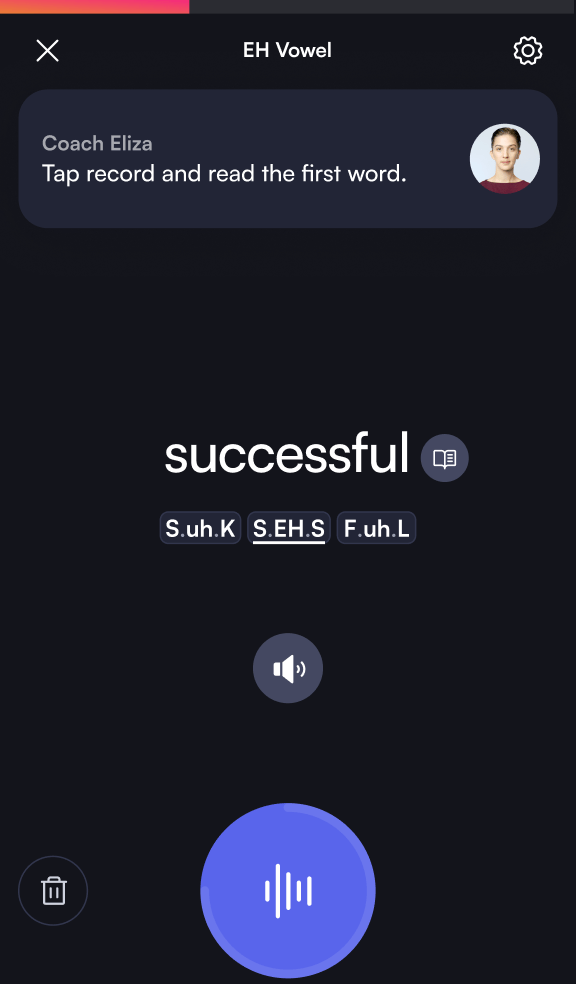
See what gets in the way
Say a word or sentence and the AI scores each sound and stressed syllable, so you know which vowel or ending makes a word hard to understand.
Lessons from Hollywood coaches
Video lessons with coaches Ron Carlos and Eliza Simpson show the tongue and lip positions up close, like the clips on this page.
In Spanish, wherever you are
The iOS and Android app is available in Spanish: menus and instructions in your language while the practice stays in English. BoldVoice also runs on the web, in English. 7-day free trial.
Questions Spanish speakers ask
What are the hardest English sounds for Spanish speakers?
In BoldVoice practice data, the sounds Spanish speakers miss most are Z (heard as S in about 90% of those misses), the short A in cat, the short OO in full, the AH in hot, the ZH in measure and the TH in other. Vowel pairs like ship and sheep, the extra E before S, B and V, and the American R complete the usual list.
How do Spanish speakers pronounce the English TH?
Spanish speakers most often replace the TH in other with a D (about 70% of misses in BoldVoice practice data) and the TH in think with a T (about 50% of misses). To fix both, rest the tip of your tongue lightly between your teeth and push air out: no voice for think, voice on for other. The soft d in nada and dedo is close to the TH in other.
Why do Spanish speakers say “jes” instead of “yes”?
In many Spanish dialects, the y in yo and the ll in llamar are said with the tongue pressed close to or against the roof of the mouth, which sounds like an English J. Carried into English, yes can sound like Jess and yellow like jello. For the English Y, keep a small gap: start from a quick “ee” and glide into the vowel, ee-es.
Do speakers from Spain and Latin America have the same English pronunciation problems?
Mostly yes. Spanish speakers from Spain and Latin America share five vowels, the extra E before S, merged B and V, and a tapped R. The main difference is TH: most of Spain says the z in zapato as the TH in think, so that sound is already familiar, while Latin America says it as S. Speakers from the Caribbean and southern Spain often soften S at the end of a syllable, so English plurals need extra care.
Do Spanish speakers have any advantage in English pronunciation?
Yes. The Spanish tap in pero is the sound Americans use for the T in water, better and city. In BoldVoice data, Spanish speakers produce that flap on about 80% of first attempts across 14 common flap-T words, compared with about 55% for all learners. Spanish speakers also miss the American R less often than average: about 20% of the time, against 30% for all learners.
How long does it take to improve English pronunciation?
In BoldVoice data, Spanish-speaking learners who kept practicing missed fewer sounds by their fourth week. Among those who practiced TH sounds in both their first and fourth week, the typical TH miss rate fell from about 40% to about 25%, and about 75% of them improved. Across all sounds, the typical miss rate fell from about 25% to about 20%.
Can an adult change a Spanish accent in English?
Yes, and the goal is being understood the first time and speaking with confidence, not erasing your accent. Pronunciation is a set of mouth movements, and adults learn new ones with focused practice and clear feedback. Focusing on the few sounds that cause the most misunderstandings can help make your speech easier to understand.
Is BoldVoice available in Spanish?
Yes. The BoldVoice iOS and Android app can be used in Spanish, so menus and instructions appear in Spanish while you practice English. Video lessons are taught in English by Hollywood coaches Ron Carlos and Eliza Simpson, with AI feedback on every sound and on word stress. BoldVoice also runs on the web, in English, and new users get a 7-day free trial.
Start with the sounds that matter for you
See which sounds get in the way of being understood, and practice those first, with video lessons from Hollywood coaches.
7-day free trial. iOS and Android app available in Spanish.
Last updated