

Clear English for Chinese speakers
Chinese speakers usually find English endings hardest: the L in “feel”, the D in “food” and consonant clusters fade or drop. The TH in “think” often becomes S or F, V drifts toward F or W, and “ship” merges with “sheep”. Each is a habit you can retrain.
Try it
TH for Chinese speakers: why “think” becomes “sink” or “fink”
Which word did Eliza say?
Word 1 of 4
Listen, then pick the word.
How to make TH
Mandarin and Cantonese speakers replace TH with different sounds. When Mandarin speakers miss the TH in “think”, about 50% of those misses come out as S; when Cantonese speakers miss it, about 70% come out as F, so “three” sounds like “free”. The TH in “this” most often becomes D for both, missed about 40% of the time by Mandarin speakers and about 55% by Cantonese speakers.
Show the tongue
Rest the tip of your tongue lightly between your front teeth, or just touching the back of the top ones.
Push air over it
For “think”, blow air through the gap without moving the tongue. If you hear S, the tongue has pulled back; if you hear F, your lower lip is touching your teeth.
Add voice for “this”
Same position, with your voice on so the tongue tickles. Do not press hard, or it turns into D.
More TH words
BoldVoice data
What do Chinese speakers find hardest in English?
Mandarin vs Cantonese vs all learners
Miss rate per learner, averaged across learners
| Sound | Mandarin | Cantonese | All |
|---|---|---|---|
| Flap Twater, better | 65% | 65% | 50% |
| L after a vowelfeel, world | 60% | 65% | 30% |
| Voiced THthis, other | 40% | 55% | 40% |
| Voiceless THthink, three | 30% | 35% | 40% |
| Vvery, voice | 25% | 40% | 25% |
| American Rher, work | 25% | 40% | 30% |
| Short Iship, pill | 35% | 25% | 30% |
| Final consonant dropped | 10% | 10% | 5% |
On this page, “Mandarin speakers” and “Cantonese speakers” means a learner’s self-reported native language, and “all learners” means every BoldVoice learner in the sample.
How we measured this
Figures come from an anonymized sample of 750,000 BoldVoice practice attempts.
Why do Chinese speakers drop final consonants?
Mandarin allows only a vowel, n, ng or the “er” of èr at the end of a syllable. Cantonese’s final p, t and k are held closed and never released, a habit that carries over well, since English speakers often leave final stops unreleased too. The endings neither language uses (L, S, Z, V, D and clusters) are the ones that fade or drop.
That happens in three ways: the consonant drops (“hand” as “han”), a vowel gets added (“good” as “good-uh”), or a voiced ending loses its voice, so “food” sounds like “foot”. In our data, Mandarin and Cantonese speakers drop a word’s final consonant about 10% of the time, against about 5% for all learners.
Finish the word
Say the last sound on its own first (“d”, “l”, “z”), then attach it to the word.
Keep the voice on
For D, Z and V endings, keep your voice buzzing into the consonant. The vowel before a voiced ending is a little longer: “food” is longer than “foot”.
No extra vowel
Close the consonant and stop. If you hear “uh” after “good”, shorten the release.
Hear the final D
Why does the L disappear in “feel” and “world”?
The L disappears in “feel”, “call” and “world” because Mandarin uses L only at the start of a syllable, as in “lǎoshī”. After a vowel the mouth has no habit for it, so the L is dropped or turned into a vowel close to “oh”. It is the largest gap in our data: Mandarin speakers miss the L after a vowel about 60% of the time and Cantonese speakers about 65%, against about 30% for all learners. Across all of their L errors, Mandarin speakers drop the sound entirely about 85% of the time. On a phone call, that can turn “I’ll call you back” into “I call you back”.
Touch the tip
Put the tongue tip on the ridge behind your upper front teeth and keep it there until the word ends.
Keep the lips relaxed
If your lips round forward, the L turns into “oh”. Leave them neutral.
Lift the back of the tongue
After a vowel, the American L is “dark”: the back of the tongue rises toward the soft palate while the tip stays up.
“World” stacks this L with the American R and a final D: Mandarin speakers fail their first try at it about 70% of the time (about 65% for all learners), miss its L about 50% of the time and its final D about 45%, most often saying T. The full breakdown is in how to pronounce “world”.
Hear the final L
Why do Chinese speakers mix up V and W, or S and Z?
Z said as S
English uses Z in many words spelled with S: “is”, “was”, “does”. Pinyin “z” is a voiceless [ts], like the end of “cats”, not an English Z. Mandarin speakers miss Z about 40% of the time and Cantonese speakers about 55%; when they do, it is heard as S about 80% and 90% of the time. The fix is voice: hold a hissing S, then switch your voice on without moving your tongue.
V said as F or W
When V is missed, F is the most common replacement. Cantonese speakers miss V about 40% of the time, about 75% of those as F, and Mandarin speakers about 25%. Some Mandarin speakers say W with the lip close to the teeth, so “very” and “wary” drift together. For V, rest your top teeth on your lower lip and buzz. For W, round your lips forward; your teeth touch nothing.
N and L, for some southern speakers
In several southern Chinese dialects, and for many Hong Kong Cantonese speakers, N and L at the start of a syllable merge, so “night” and “light” can sound alike. Use your nose as the check: hum an N and it vibrates; on L the air flows around the sides of the tongue and the nose stays still.
V: teeth on lip
W: rounded lips
Flap T: why “water” can sound too careful
“Water” sounds too careful when its T is a full, crisp T, because American English uses a flap there: a quick tap of the tongue, close to a light D, for a T between vowels before an unstressed syllable, as in “water”, “better” and “city”. Across first tries at 14 flap T practice words, Mandarin speakers say a full, crisp T about 35% of the time, against about 5% for Spanish speakers, and land the flap only about 35% of the time (about 55% across all learners). Cantonese speakers show the same split.
A full T is still clear, just more word by word. To flap, tap the tongue tip once against the ridge behind your top teeth, too briefly to build the puff of a full T. More in the American flap T guide.
Hear the flap
Why do “ship” and “sheep” sound the same?
“Ship” and “sheep” sound the same to many Chinese speakers because English pairs a tense vowel with a shorter, relaxed partner (“sheep” and “ship”, “fool” and “full”) that Mandarin does not separate, and Cantonese has the relaxed versions only before certain endings. The relaxed vowel gets replaced by its tense neighbor. Mandarin speakers miss the short I about 35% of the time, about 65% of those as EE, and the short OO in “good” about 40% of the time, about 60% of those as the OO in “food”.
Change the vowel quality, not just its length. For “ship”, let the smile of EE go and drop the jaw slightly. For “full”, round your lips less than for “fool” and keep the tongue relaxed.
BoldVoice data
Which English words do Mandarin speakers miss most?
- genres95% failed first tryPractice
- fulfill95% failed first tryPractice
- mirages90% failed first tryPractice
- genre90% failed first tryPractice
- worthwhile90% failed first tryPractice
- another90% failed first tryPractice
- southern85% failed first tryPractice
- visuals85% failed first tryPractice
- childhood85% failed first tryPractice
How BoldVoice trains Chinese speakers
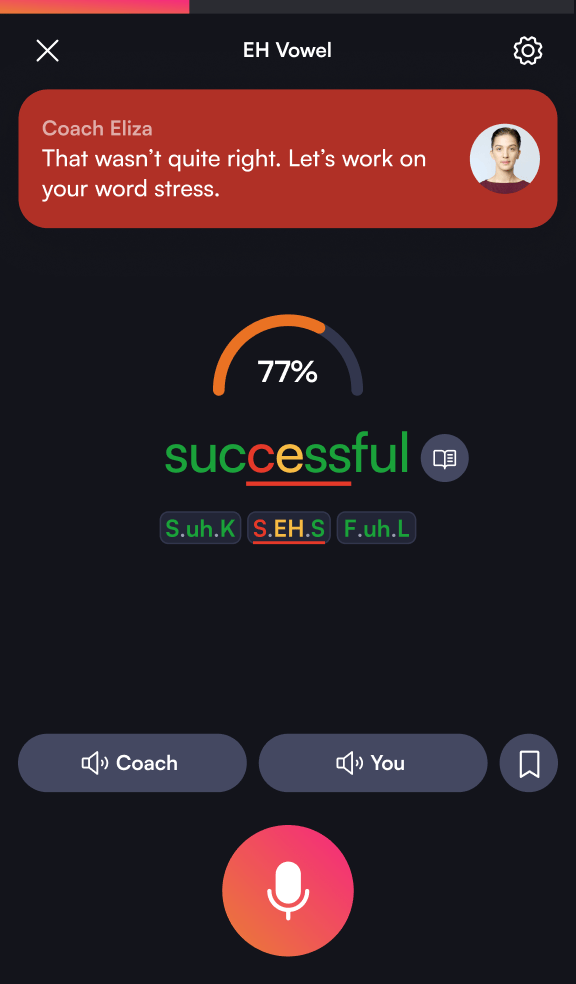
A plan built around your first language
Tell BoldVoice you speak Mandarin or Cantonese and the course skips what you already pronounce well, then focuses on the challenges above.
See what gets in the way
Say a word or sentence and the AI scores each sound and the word stress, so you know whether the L, the TH or the ending made it hard to understand.
Coaches, and an app in Chinese
Video lessons from Hollywood coaches Ron Carlos and Eliza Simpson, on iOS, Android and the web. The iOS and Android app is available in Simplified and Traditional Chinese.
Questions Chinese speakers ask
What are the most common pronunciation mistakes Chinese speakers make in English?
In BoldVoice data, Chinese speakers struggle most with the L after a vowel ("feel"), which Mandarin speakers miss about 60% of the time against about 30% for all learners, and the flap T in "water". Next come the TH in "think" (said as S or F), the TH in "this" (said as D), Z said as S, and short vowels such as the I in "ship". Each traces back to a sound or syllable ending Mandarin or Cantonese lacks.
Is English pronunciation harder for Mandarin or Cantonese speakers?
Neither is simply harder; the patterns differ. In BoldVoice data, Cantonese speakers miss Z (about 55% vs 40%), V (about 40% vs 25%) and the TH in "this" (about 55% vs 40%) more often than Mandarin speakers, while both groups miss the flap T and the L after a vowel at similar rates. A missed TH in "think" most often becomes F for Cantonese speakers and S for Mandarin speakers.
Why can Chinese speakers sound flat or choppy in English?
Mandarin and Cantonese are tonal: pitch is part of each word, so "mā" (mother) and "mà" (to scold) are different words. English uses pitch for stress and focus instead, and shrinks unstressed syllables into a quick, weak vowel ("a-BOUT"). Giving every syllable a full vowel and an even beat can sound choppy or flat. Practice by making the stressed syllable longer, louder and higher, and letting the others shrink.
Can a Mandarin speaker learn an American accent as an adult?
Yes, and the goal is being understood, not a perfect accent. An accent is a set of physical habits in the tongue, lips and breath, and adults retrain those habits with focused practice and feedback. Start with the sounds that affect clarity most (word endings, the L after a vowel and TH), then work on word stress and sentence intonation.
How long does it take a Chinese speaker to improve English pronunciation?
Measurable progress can come within a few weeks of regular practice. Among Mandarin-speaking BoldVoice learners who practiced TH in both their first and fourth week, the typical TH miss rate fell from about 40% to about 25%, and about 75% of them improved. How fast a sound changes depends on the sound and on how often you practice it with feedback.
Should Chinese speakers learn American or British English pronunciation?
Either works: listeners around the world understand both, and being clear matters more than which model you follow. Choose the one you hear most at work or in daily life and use it consistently. This guide and BoldVoice teach American English, so details such as the flap T in "water" and the R in "work" follow American pronunciation.
How can Chinese speakers practice English pronunciation at home?
Work on one sound at a time with minimal pairs, words that differ in only that sound: "think" and "sink", "ship" and "sheep", "food" and "foot", "very" and "wary". Listen to a model, say each word slowly and then at normal speed, and record yourself, because many people cannot hear their own error while speaking. Then use the word in a sentence you actually say at work or in daily life.
Is BoldVoice available in Chinese?
Yes. The BoldVoice iOS and Android app is available in Simplified Chinese and Traditional Chinese, as well as English and other languages. Video lessons are taught in English by Hollywood coaches Ron Carlos and Eliza Simpson, with AI feedback on every sound and on word stress. BoldVoice also runs on the web, and there is a 7-day free trial.
Start with the sounds that matter for you
7-day free trial on iOS, Android and the web.
Last updated