You can practice clear English from anywhere in Vietnam, online. For Vietnamese speakers, word endings are the place to start: the D in “bad”, the -ed in “worked” and the Z in “days” get dropped or cut short. Then work on linking words.
“This hiccup sound, also known as a glottal stop, is a defining feature of the Vietnamese accent in English.” Ron Carlos, BoldVoice coach
Listen first
Can you hear the last sound?
Each pair differs only in its last sound. Vietnamese has final P, T and K, usually unreleased, but no final B, D or G, so the voiced half of each pair is the new habit.
Ends in T or D
Ends in K or G
Ends in P or B
Which word did the coach say?
Word 1 of 6
Listen, then pick the word.
Why does a Vietnamese accent drop the ends of English words?
Vietnamese speakers drop English word endings because a Vietnamese syllable can end in only a few sounds, so endings like B, D, G, S, Z, L and consonant clusters have no matching habit.
Vietnamese is a tonal, largely monosyllabic language. A syllable can end in a vowel or glide, a nasal (written m, n, ng or nh), or a stop written p, t, c or ch, and those final stops are usually unreleased: your lips or tongue close, and the sound simply stops there.
English allows far more at the end of a word: voiced stops (bad, bag, cub), hissing and buzzing sounds (bus, days, wish), L (feel), and clusters (asked, months, texts) that Vietnamese never has; its letter pairs tr, ch and ng each spell a single sound. With no matching habit, these endings get dropped, swapped for a voiceless sound, or closed off in the throat.
A glottal stop is the catch in the middle of “uh-oh”, made by briefly closing your vocal folds. Vietnamese words that start with a vowel begin with one, and Hollywood coach Ron Carlos hears the same catch closing off P, T and K when Vietnamese speakers speak English. When it replaces a final consonant, or interrupts a phrase, it chops up words native speakers run together and hides whether you said P, T or K.
Our data
Which English sounds are hardest for Vietnamese speakers?
In BoldVoice practice data from about 1,000 Vietnamese speakers, the most-missed English sound was the ER in “first” (60% miss rate), followed by the flap T in “water” (55%). The biggest gap next to all learners was the dark L of “feel” and “world”: 65% against 30%.
ER, as in “first”60%
/ɝ/, most often heard as a plain “uh”
Flap T, as in “water”55%
/ɾ/, most often heard as a D
TH, as in “this”45%
/ð/, most often heard as a D
OR, as in “more”45%
/ɔɹ/, most often heard as AW with no R
Z, as in “days”45%
/z/, most often heard as an S
OO, as in “good”45%
/ʊ/, most often heard as the long OO of “food”
TH, as in “think”40%
/θ/, most often heard as a T
AR, as in “car”40%
/ɑɹ/, most often heard as AH with no R
J, as in “job”40%
/dʒ/, most often heard as a CH
L, as in “people”35%
/l/, most often dropped
Compared with all learners
Average miss rate per learner by sound type, Vietnamese speakers compared with all BoldVoice learners
Sound
Vietnamese
All learners
Dark L (L after a vowel: feel, world)
65%
30%
-ed endings (worked, played)
45%
35%
American R (ɹ and r-colored vowels)
45%
30%
Flap T (water, better)
55%
50%
TH as in “this” (ð)
45%
40%
TH as in “think” (θ)
40%
40%
Final consonant dropped
10%
5%
On this page, “Vietnamese speakers” means about 1,000 BoldVoice learners who list Vietnamese as a native language. The figures on this page cover Vietnamese speakers wherever they live.
How we measured this
Figures come from an anonymized sample of 750,000 BoldVoice practice attempts.
How to fix it
Six habits for clear American English
To speak clearer English, Vietnamese speakers should start with word endings: release a final P, T or K, keep the voice on through B, D and G, and finish every -s and -ed. Our data and Ron’s lessons for Vietnamese speakers both point there first.
Habit 1
Release P, T and K at the end of a word
To release a final P, T or K, stop the air in your mouth, not your throat; that is Ron’s fix for the glottal stop. Say “sap” and feel the air press behind your lips before you let it go. For “sat”, the pressure builds behind the tip of your tongue; for “sack”, behind the back of your tongue.
Native speakers do not always release these in fast speech, but while you train, a small, audible release tells the listener which consonant you meant.
A voiced ending lengthens the vowel before it, so “bad” is longer than “bat”, and “bag” is longer than “back”. Listeners rely heavily on that length, and on a phone call it can be the only clue to which word you said. Rest your fingers on your throat and keep the buzz going into the final consonant; native speakers often let it fade at the very end, but they keep the vowel long.
Ron’s check in the clip: keep the D a D, not a T, and “make sure you don’t add a big vowel at the end, like ‘head-uh.’ It’s just ‘head.’”
Ron’s quick fix: a final D should not turn into a T, and should not grow a big extra vowel.
Habit 3
Finish every -s and -ed ending
The -s and -ed endings carry grammar: “I work there” and “I worked there” are different sentences. Each has three pronunciations, chosen by the sound before it.
-s: an extra “iz” syllable after hissing and hushing sounds (buses, wishes, changes). Otherwise S after voiceless sounds (cats, texts) and Z after voiced sounds (days, goes, dogs).
-ed: an extra “id” syllable after T or D (wanted, needed). Otherwise T after voiceless sounds (worked, helped) and D after voiced sounds (played, called).
In our data, the final T or D of words spelled with -ed had a 45% miss rate for Vietnamese speakers, most often a D turned into a T, so “played” sounds closer to “plate”.
Vietnamese has no L at the end of a syllable, so “feel”, “school” and “people” often lose it, and in a meeting “I’ll send it” can come out as “I send it”. Touch the tip of your tongue to the ridge behind your upper teeth and keep it there as the word ends. The back of the tongue lifts a little, which gives the American final L its darker sound. Our guide to pronouncing “world” takes it step by step.
A glottal stop before every vowel makes “Is it okay?” sound like three separate words. Ron’s advice is to “imagine that the last sound of each word actually starts the following word”: “is” runs into “it”, and “it” runs into “okay”.
The flap T is a quick tap of the tongue tip, lighter and faster than a full D, that replaces the American T between two vowels before an unstressed syllable, as in “water” and “better”. In about 680 first tries at flap words by Vietnamese speakers, our scorer heard a full D 40% of the time and a real flap 45%. Before a stressed syllable (“attack”) it stays a clear T. The flap T guide has more examples.
Each Vietnamese syllable carries its own tone, which pulls English toward equal weight on every syllable. Stress placement was off in only about 5% of multi-syllable words for Vietnamese speakers (5% for all learners). Sentence rhythm is worth practicing too: let small words like “is”, “it”, “to” and “and” go short and quick, and save the length for the words that carry the meaning.
Ron replaces the glottal stop in “water” with a quick tap.
Habit 6
Add TH, J and the American R
Vietnamese has no TH sound (its written “th” is a breathy T), so “think” drifts to “tink” and “this” to “dis”. Put the tip of your tongue lightly between your teeth and blow: no voice for “think”, voice on for “this”.
J, as in “job”, is CH with the voice switched on. Keep the buzz going, or “jeep” lands close to “cheap”.
The American R vowel in “first”, “work” and “world” was the most-missed sound in our Vietnamese data, most often relaxed into a plain “uh”. Pull your tongue back and up without touching the roof of your mouth, round your lips slightly, and hold that shape through the whole vowel.
BoldVoice is a speaking coach for non-native English speakers, built around video lessons from Hollywood coaches Ron Carlos and Eliza Simpson and AI feedback on individual sounds and word stress.
9:41
Coach video lessons
Learn each sound from Ron and Eliza, including Ron’s lesson on the glottal stop for Vietnamese speakers.
See what gets in the way
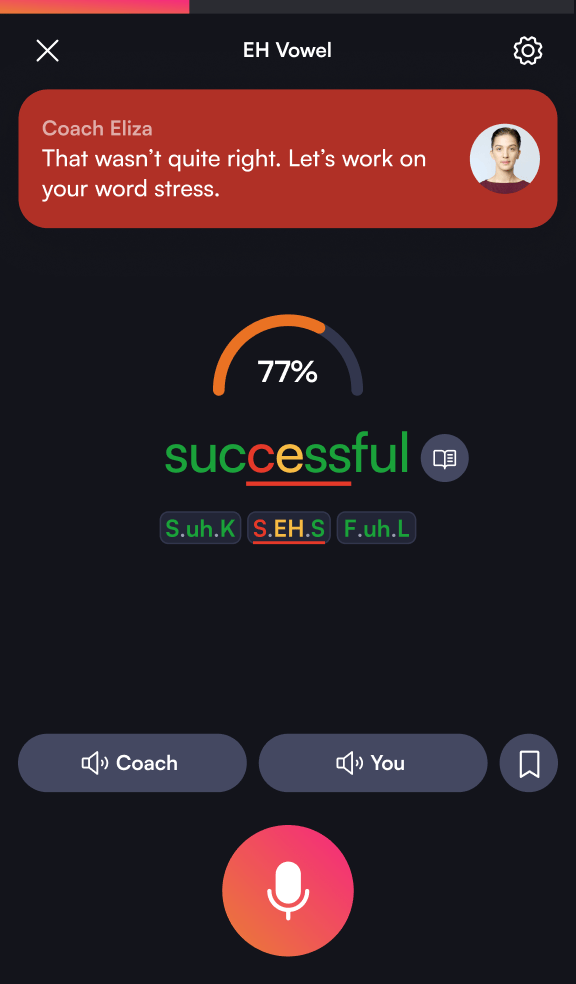
Say a word or sentence and see each sound and your stress scored, so you can tell when a D comes out as a T and changes the word.
Practice anywhere
Use it on iOS, Android or the web, with a 7-day free trial.
Frequently asked questions
What is the hardest part of English pronunciation for Vietnamese speakers?
Word endings. Vietnamese syllables end in only a few consonants, and their final stops are usually unreleased, so English endings like the D in “bad”, the -ed in “worked”, the Z in “days” and the L in “feel” get dropped or changed. In BoldVoice practice data, Vietnamese speakers had a 65% miss rate on the dark L and 45% on the final T or D of words spelled with -ed.
Do I need to lose my Vietnamese accent to be understood in English?
No. The goal is to be understood the first time, not to sound like someone else. Listeners ask you to repeat yourself when a sound changes or hides the word, and for Vietnamese speakers that usually means a dropped or shortened ending (“work” for “worked”, “bat” for “bad”) or a glottal stop that chops a phrase into separate words. Fix those, and your accent can stay part of who you are.
Do I need an American accent for IELTS Speaking?
No. Pronunciation is one of four IELTS Speaking criteria, next to fluency and coherence, lexical resource, and grammatical range and accuracy, and the official band descriptors judge how easily you are understood, not which accent you have. At band 9 they say, “Accent has no effect on intelligibility.” For Vietnamese speakers, the features most likely to cost clarity are endings that change the word (“work” for “worked”) and speech that stops between words instead of linking.
Which English words are hardest for Vietnamese speakers?
Words that pile new habits into the ending. “World” needs the American R vowel and then an L and a D, “asked” and “texts” end in consonant clusters, “months” puts TH before S, and past-tense verbs like “worked” and “played” need a final T or D. Words with the ER in “first” (60% miss rate) or the flap T in “water” (55%), the two sounds Vietnamese speakers missed most in our data, are worth practicing early too.
Where does clear American English matter most in Vietnam?
Wherever English is the working language: calls with clients and teammates abroad in Vietnam’s software outsourcing and IT services industry, interviews for remote jobs with foreign companies, university and scholarship interviews, and hotels, tours and restaurants, where short, fast phrases leave no room for a missing sound. Clear endings matter most, because a dropped ending can turn a past-tense update (“I fixed the bug”) into a promise.
What is a glottal stop, and why does it matter in a Vietnamese accent?
A glottal stop is the small catch in your throat in the middle of “uh-oh”. Vietnamese uses it at the start of words that begin with a vowel. When it replaces a final consonant entirely, so the lips or tongue never close, or breaks up a phrase that should flow together, listeners can lose track of which consonant you meant and ask you to repeat yourself.
How long does it take to improve English pronunciation?
Some sounds improve within weeks. Among BoldVoice learners who practiced TH in both their first and fourth week, the typical TH miss rate fell from about 45% to about 25%. Make the flap T part of your regular practice from the start.
Can I do American accent training online from Vietnam?
Yes. BoldVoice is a speaking coach that helps you be understood, and it runs on iOS, Android and the web, with video lessons from Hollywood coaches Ron Carlos and Eliza Simpson and AI feedback on individual sounds and word stress. It starts with a 7-day free trial.
Is the BoldVoice app available in Vietnamese?
The interface is not available in Vietnamese. It comes in English, Spanish, French, Hindi, Japanese, Korean, Portuguese, Russian, Turkish, and Simplified and Traditional Chinese. The coach lessons and practice are in English, and Ron Carlos has recorded a lesson specifically about the glottal stop in a Vietnamese accent.
Start with your word endings
See which endings and sounds get in the way of being understood, and practice those first, with video lessons from Hollywood coaches.