

Speak as clearly as you code
For software engineers with English as a second language, being easy to follow often comes down to a few sounds and stress patterns in tech words: the flap T in “data”, the stress in “development”, “cache” said “cash”. Practice them out loud with feedback.
Listen first
Hear the tech words you say every day
data
DAY-duh or DA-duh /ˈdeɪɾə/The T is a quick tap of the tongue, close to a soft D.
parameter
puh-RAM-ih-der /pəˈræmɪɾɚ/Stress RAM, with the open “a” of “cat”. The T after it is tapped.
module
MAH-jool /ˈmɑdʒul/The D blends into the next sound, like the J in “judge”.
version
VER-zhun /ˈvɝʒən/The S sounds like the middle of “measure”. For the V, touch your top teeth to your lower lip.
upload
UP-lohd (noun) /ˈʌpˌloʊd/The noun stresses UP; the verb can also be up-LOHD.
digital
DIJ-ih-dl /ˈdɪdʒɪɾəl/Stress DIJ. The T between the vowels is tapped.
design
dih-ZINE /dɪˈzaɪn/The S is a Z sound, the G is silent, and the stress is on the second syllable.
project
PRAH-jekt (noun) /ˈpɹɑdʒɛkt/As a noun, stress PRO. As a verb (“to project”), stress JECT.
How do you pronounce “data”?
“Data” is pronounced “DAY-duh” or “DA-duh” (with the vowel of “cat”); both are standard. In American English the T in “data” is a flap T: one quick tap of the tongue tip on the ridge behind the top teeth, shorter than a D. A T becomes a flap between vowels before an unstressed syllable, as in “parameter” and “digital”.
A clear T is never wrong: it is normal in British English and understood everywhere. Knowing the flap mostly helps you follow American colleagues.
More flap words you will say at work
- betaBAY-duh
- iterateID-er-ate
- updatedup-DAY-did
- metadataMED-uh-day-duh
- computerkum-PYOO-der
- laterLAY-der
Go deeper with the American flap T guide.
What our scorer heard at the flap
First tries at 14 common flap words, such as water, city and data (about 26,000 attempts).
- A flap55%
- A D sound20%
- A full T20%
- Something else, or dropped5%
Which stress shifts trip up engineers?
- UPdate (noun)vsupDATE (verb, often)
- Give an UPdate in the standup; upDATE the ticket after.
- STRATegyvsstraTEgic
- The stress jumps one syllable to the right.
- PROductvsproDUCtive
- Same root, different beat.
- ANalyzevsaNALysis
- Then anaLYtical: three related words, three stress positions.
- EXecutevsexECutive
- The command you run and the person you report to.
- ALgorithmvsalgoRITHmic
- The TH is voiced, as in “this”.
Hear “straTEgic”
Hear “proDUCtive”
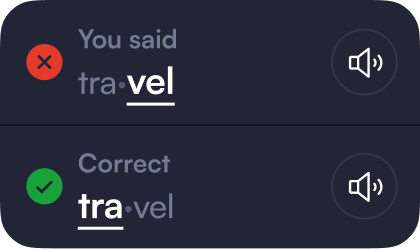
BoldVoice shows the syllable you stressed next to the one a listener expects.
How to stress a syllable
Make it longer, a little louder and a little higher, with a full vowel, and let the others shrink, often to a quick “uh”. Tap it on the desk: deVELopment is da-DUM-da-da.
How do you pronounce cache, queue and other tech words?
Spelling traps
- cache
- Like “cash”
- Not “catch”, and not “cash-AY” (that is “cachet”, a different word).
- queue
- Like “cue”
- Five letters, one syllable: it sounds like the letter Q.
- suite
- Like “sweet”
- A test suite is a “sweet”, not a “suit”.
- machine
- muh-SHEEN
- CH spells an SH sound, and the stress is on the second syllable.
- company
- KUM-puh-nee
- The first O sounds like the U in “cup”.
- hierarchy
- HY-er-ar-kee
- Stress the first syllable. A three-syllable HIGH-rar-kee is also standard. Either way, keep the R in “ar”.
- schedule
- SKEJ-ool
- Most Americans say the SCH as “sk” and the D like the J in “judge”.
- nginx
- “engine X”
- That is how the project itself says it.
Hear “machine”
Hear “company”
Where engineers disagree
These have more than one accepted pronunciation, so pick one and say it confidently. Even MySQL’s own reference manual prefers “My S-Q-L” but says “my sequel” is fine.
- SQL
- “S-Q-L” or “sequel”
- Kubernetes
- koo-ber-NET-eez
- The stress on NET is the constant; the rest varies by team.
- GUI
- “GOO-ee” or “G-U-I”
- Most people say it as one word.
- char
- “char”, “car” or “care”
- epoch
- “EP-uk” or “EE-pok”
- router
- “ROW-ter” or “ROO-ter”
- Americans usually rhyme it with “outer”; British speakers say “ROO-ter”.
From our practice data
Which tech words do learners miss most?
- parameter70%
- hierarchy65%
- data55%
- develop50%
- development45%
- update35%
What trips them up
- Parameter: the stressed “a” of RAM was off in 60% of first tries, most often heard as “ah”.
- Hierarchy: the “ar” was off in 60%, most often because the R was dropped.
- Data: the flap was off in 45%, most often heard as a D. Of learners who missed it at first, 60% passed later, typically within a few more tries.
How we measured this
Figures come from an anonymized sample of 750,000 BoldVoice practice attempts.
How do you say numbers, versions and acronyms out loud?
- v3.11
- “three point eleven”, often just “three eleven”
- v2.0
- “two point oh” or “two point zero”
- 3.11 (a decimal)
- “three point one one”
- 10.0.0.1
- “ten dot zero dot zero dot one”
- 13 ms vs 30 ms
- “thir-TEEN” with a clear T, vs “THIR-dee” with a flap. If it is critical, add the digits: “thirteen, one-three”.
- API, URL, CLI
- Letter by letter, stress on the last letter: “ay-pee-EYE”
- JSON
- Said as a word, most often “JAY-sun”
- getUserById
- “get user by I-D”: say identifiers as the words they contain
How do you explain a technical idea so people can follow?
One sentence, four thought groups
The deploy FAILED / because the cache was STALE, / so I rolled it BACK / and added a TEST.
- One idea per group, then pause. Listeners get time to process, and you get time to plan.
- Stress the new word in each group. Often the last content word: the thing your listener did not know yet.
- Land a finished point with a fall. A rise signals that more is coming or that you are asking.
- Signpost. “Two things. First, … Second, …” tells people how much is coming, which matters even more on a call.
Say these out loud
Standup
Yesterday I fixed the data export. Today I'm updating the parameter docs. No blockers.
Code review
I'd rather cache the result than add another queue. It keeps the latency predictable.
Interview
Let me walk you through the trade-offs. First, latency. Second, cost.
How BoldVoice works
See what gets in the way
Say a word or sentence and the AI scores each sound and your word stress, so you know what makes a word hard to understand.
Lessons from Hollywood coaches
Video lessons with coaches Ron Carlos and Eliza Simpson show the mouth up close, like the clips on this page.
Your own work words
Tap Practice on a tech word above to say it yourself and get a score on each sound.
Questions engineers ask
How do you pronounce "cache"?
"Cache" is pronounced exactly like "cash": one syllable, /kæʃ/. It is not "catch", and not "cash-AY", which is the separate word "cachet". Every form keeps that sound: "cached" sounds like "cashed", "caching" is "CASH-ing", and a "cache miss" is said "cash miss".
Should I use American or British pronunciation at work?
American and British pronunciation both work in tech. Engineers around the world understand both, so pick one and use it consistently. If most of your colleagues are American, learning American patterns such as the flap T in "data" and "parameter" helps you follow them on fast calls, even if you keep a clear T yourself. BoldVoice coaches Ron Carlos and Eliza Simpson teach American English.
Is it "S-Q-L" or "sequel"?
SQL is pronounced both "S-Q-L" and "sequel", and both are widely understood. MySQL's reference manual prefers "My S-Q-L" but accepts "my sequel". The PostgreSQL project says "post-gres-Q-L", and "Postgres" is a common short name. SQLite is said both ways too. In a new team, listen for a week and match what your colleagues say.
Why do coworkers ask me to repeat myself?
Coworkers usually ask you to repeat yourself because of a few habits, not your accent as a whole: stress on the wrong syllable, since listeners lean on stress to recognize words; a handful of sounds that blur a word, like the flap T in "data" or the R in "hierarchy"; and speaking fast without pauses. Fixing those few things is what gets you understood the first time.
How can I speak more clearly in standups?
Lead with the outcome, keep one idea per phrase, and pause briefly between phrases. Stress the key word in each phrase, usually the new information. Then practice out loud the handful of words you say every day, such as data, update and parameter, plus the names of your own services, until they come out right without thinking.
How do you sound clear in a technical interview?
Rehearse the words you will say most (your stack, past companies and project story) out loud in full sentences over several days. Restate the question to confirm it and buy time to plan. Think aloud in short phrases, slowing down on names and numbers. If you miss something, "Sorry, could you repeat the last part?" is normal and better than answering the wrong question.
Do I need to lose my accent to succeed as a software engineer?
No. Many excellent engineers have strong accents, and distributed teams hear many accents every day. What matters is being understood on the first try, which usually means fixing a few specific sounds and stress patterns, not changing how you sound overall. Clear stress, steady pace and short pauses do more for a listener than any particular accent.
Is there an app for English pronunciation practice for engineers?
BoldVoice is a speaking coach for non-native English speakers. You say a word or sentence and its AI scores each sound and your word stress, and video lessons from Hollywood coaches Ron Carlos and Eliza Simpson show the mouth up close. You can practice the tech words on this page with it, on iOS, Android or the web, with a 7-day free trial.
Start with the words you say at work
See which sounds and stress patterns get in the way of being understood, and practice those first, with video lessons from Hollywood coaches.
7-day free trial on iOS, Android and the web.
Last updated