Good English pronunciation for nurses is not a new accent. It means the important words land the first time: clear word stress, finished consonants and numbers said distinctly. BoldVoice trains that, with Hollywood coaches and feedback on every sound.
“The most common pronunciation in the US is with three.” Eliza Simpson, BoldVoice coach, on “comfortable”
Tap to hear
How do you pronounce common medical words?
Say “doctor” as DAHK-ter, “tissue” as TISH-oo and “insurance” as in-SHUR-uhns, stressing the syllable in capitals. Hear Hollywood coaches Ron Carlos and Eliza Simpson say eight words nurses use every shift.
Watch the mouth: doctor, breathe, comfortable, health, tissue, therapy.
In BoldVoice practice data, “anesthesia” is the hardest of these clinical words: about 95% of learners missed it on their very first try, followed by “breathe” and “schedule” at about 55%.
Missed on the first try
anesthesia95%
breathe55%
schedule55%
pill50%
hospital45%
medication35%
temperature35%
pressure30%
swallow30%
anesthesia
an-uhs-THEE-zhuh /ˌænəsˈθiʒə/
70% of first tries missed the TH, 60% the ZH
In “anesthesia”, the TH most often became a T (“anes-TEE-sia”): rest the tongue tip lightly between your teeth and let air flow. The ZH, as in “measure”, most often became a Z.
medication
med-uh-KAY-shun /ˌmɛdəˈkeɪʃən/
45% of first tries missed a schwa
In “medication”, a full “ee” most often replaced the relaxed “uh”. Keep the unstressed syllables tiny so KAY stands out: med-uh-KAY-shun, not med-ee-KAY-shun.
pill
PIL /pɪl/
40% of first tries missed the vowel
“Pill” most often came out as “peel”. Keep the short I relaxed and short, then end with the tongue tip on the ridge behind your top teeth for the L.
hospital
HAHS-pih-dl /ˈhɑspɪɾəl/
30% of first tries missed the final L
The final L of “hospital” was most often dropped. All the weight is on HAHS, the end shrinks to a quick “dl”, and the T is a quick tap, the same flap T as in “water”.
schedule
SKEJ-ool /ˈskɛdʒul/
25% of first tries missed the J sound, 25% the final L
“Schedule” is “SKEJ-ool” in the US and often “SHED-yool” in the UK; both are correct. The J most often softened to “zh”, and the L was most often dropped.
How we measured this
Figures come from an anonymized sample of 750,000 BoldVoice practice attempts.
Breath or breathe: why does one letter matter?
“Breath” (BRETH) is the noun, with a short vowel and an airy TH; “breathe” (BREETH) is the verb, with a long “ee” and a buzzing TH. About 55% of learners missed “breathe” on their first try, and about 40% of first tries missed its TH, most often using the airy TH of “breath”.
breath
BRETH /bɹɛθ/
Short “eh” vowel, and a TH with no voice: you could whisper it. “Take a deep breath.”
“Teeth” and “teethe” split the same way. For the R, keep the tongue tip off the roof of your mouth: R was the second most often missed sound in “breathe”, most often replaced by a tap, which American ears can hear as a quick D.
Where does the stress go in medical words?
In medical words, the ending usually tells you where the stress goes: just before -tion, -sion and -ic, on -OL- in -ology, and on the “eye” syllable in -itis. Say the stressed syllable longer, louder and higher, and keep the others short.
kuh-MYOO-nih-kay-ting: Ron Carlos on three unstressed syllables in a row.
How do you say numbers and doses so they are not misheard?
To keep numbers from being misheard, stress the syllable that tells them apart: “fifteen” (fif-TEEN) is stressed on TEEN and ends in a clear N, while “fifty” (FIF-tee) is stressed on the first syllable. A mask or a phone line can erase the rest.
fif-TEEN
Stress the second syllable, make the “ee” long, and finish on a clear N.
The same pair runs from thirteen and thirty to nineteen and ninety.
In a phrase, English often moves the stress forward, so “FIF-teen minutes” can sound like “fifty minutes”. When the number matters, say it on its own with the stress on TEEN, or add the digits: “fifteen, one five”.
Contrast MIL-ih-gram and MY-kro-gram on the first syllable, and say the full unit rather than an abbreviation.
Where does being understood matter most on a shift?
Being understood matters most where a misheard word costs time or trust: handoffs, calls to physicians, patient teaching, phone and intercom, masks, and names.
The SBAR handoff
Situation, Background, Assessment, Recommendation: the fixed order only helps if each part is heard. Pause between the four parts, and stress the word that carries the news (“her pressure is DOWN”).
Calling a physician
On the phone there are no lips to read. Give your name, unit and patient first, slowly, then the reason for the call in one sentence. Expect to repeat the numbers.
Teaching a patient
A worried patient catches less. Use plain words, slow down on the medication name and the time, then ask them to explain it back.
Phone and intercom
Phone and intercom audio can blur S, F and TH, especially with background noise. Lean on clear stress and full final consonants: “fifteen” needs its N, “pill” needs its L.
Behind a mask
A mask softens sound and hides your mouth, which many listeners use without noticing. Speak a little louder and slower, and face the person.
Names, yours and theirs
Say your own name clearly once, at an even pace. With a patient name you have not heard aloud, ask how they say it and repeat it back.
How should nurses practice pronunciation?
The most practical routine for nurses is a few minutes a day on the words they actually use at work, before a shift or on a break: short, regular sessions are easier to keep up than long, rare ones.
9:41
1
Listen first.
Hear a coach say the word, and notice the stressed syllable before you try it.
2
Say it in a phrase.
Practice “take a deep breath”, not just “breath”.
3
Record and compare.
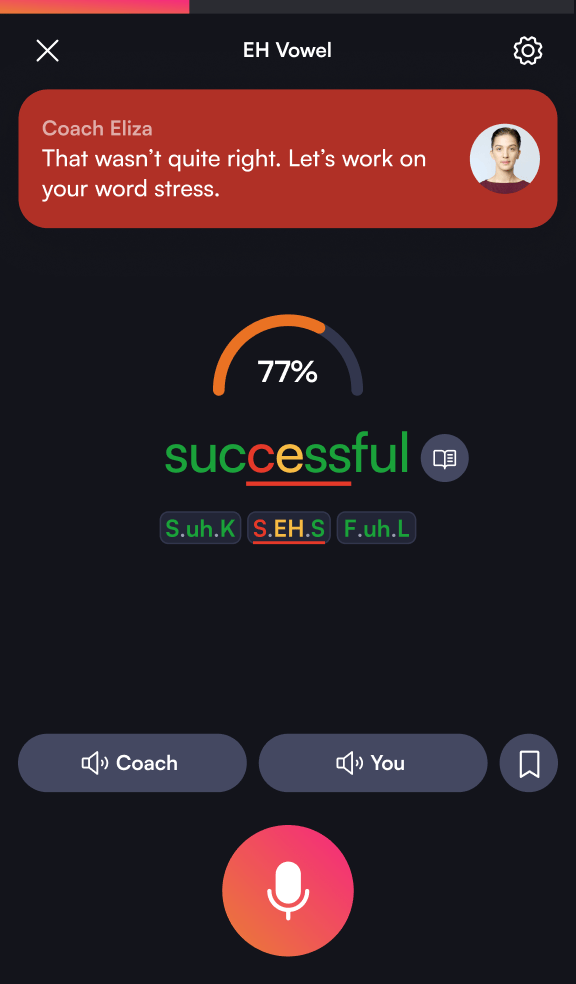
BoldVoice scores each sound and the word stress, and shows which sound slipped.
4
Use your own words.
Drug names, procedures, your colleagues’ names: pick a few from your own unit.
A practice script
For pronunciation practice only, not clinical guidance. Read it aloud, slowly first, then at your normal pace.
“Hi, this is Ana, the nurse caring for Mr. Reyes in room fifteen. I’m calling because his temperature is up and he says it hurts to breathe. He came back from surgery under general anesthesia this morning. He looks uncomfortable, and his pain medication was due at two. Could you come and see him in the next fifteen minutes?”
Questions nurses ask
Do nurses need to lose their accent to work in the US, UK, Canada or Australia?
No. An accent is not a mistake, and many excellent nurses keep theirs for life. What matters on a shift is intelligibility: key words, names and numbers heard correctly the first time. Clear word stress, finished consonants and distinct numbers do most of that work.
Why do patients keep asking me to repeat myself?
Often one or two key words did not land, not your whole accent. Common causes are stress on the wrong syllable ("MED-i-ca-tion" instead of "med-i-CA-tion"), a dropped final consonant (the L in "pill"), a short vowel made long ("pill" heard as "peel"), and speaking fast under pressure. Masks, phones and noise make each one worse, so slow down on names, numbers and drug names.
How do you speak clearly through a mask?
Give the listener more of what still gets through. Stress the key word ("the pain is in her LEFT arm"), finish your consonants (the D in "need", the L in "pill"), slow down for names, drugs, doses and times, say long numbers in small groups, and ask for a read-back on anything that matters.
Does pronunciation count in the OET Speaking test?
Yes, as one part of it. The OET Speaking sub-test is two profession-specific role-plays of about five minutes each, with three minutes to prepare for each, where an interlocutor plays your patient or their carer. Assessors rate four linguistic criteria, starting with intelligibility (pronunciation, intonation, stress and rhythm), plus five clinical communication criteria, such as relationship building and information giving.
Is BoldVoice an OET or NCLEX prep course?
No. BoldVoice is a speaking coach focused on pronunciation, not exam preparation, and it does not teach OET’s clinical communication criteria. The NCLEX is a computer-based exam with no speaking section. Clearer pronunciation, stress and rhythm can still help with the OET intelligibility criterion, alongside a dedicated OET course.
How long does it take to improve English pronunciation?
Change in a single sound can show up within weeks of regular practice. In BoldVoice practice data, among learners who practiced TH in both their first and fourth week, the TH miss rate fell from about 45% to about 25%, and about 70% of them improved. Of learners who missed "breathe" on the first try, about 60% passed it later, typically within a few more tries.
Does BoldVoice teach American or British pronunciation?
BoldVoice teaches American English pronunciation, with coaches Ron Carlos and Eliza Simpson. The habits that make you easy to understand (stress, clear consonants, distinct numbers) carry over to the UK, Canada and Australia too. The clearest difference on this page is "schedule": SKEJ-ool in the US, often SHED-yool in the UK.
Is there an app to help nurses with English pronunciation?
BoldVoice is a speaking coach app for non-native English speakers, including nurses. It scores each sound and the word stress when you speak, has video lessons from Hollywood coaches Ron Carlos and Eliza Simpson, and lets you practice clinical words like the ones on this page. It runs on iOS, Android and the web, with a 7-day free trial.